
 burn0
burn0 Silo
SiloWhat is Silo?
A local-first simulation framework for testing AI agents inside realistic business environments before production. Silo lets you bring an existing agent and run it inside a controlled world with simulated tools, seeded state, tasks, and deterministic verifiers. Your agent chooses how to act. Silo executes those actions, tracks what changed, and evaluates the final outcome. Silo is TypeScript-first, open source, and designed to work with the agent stack you already use.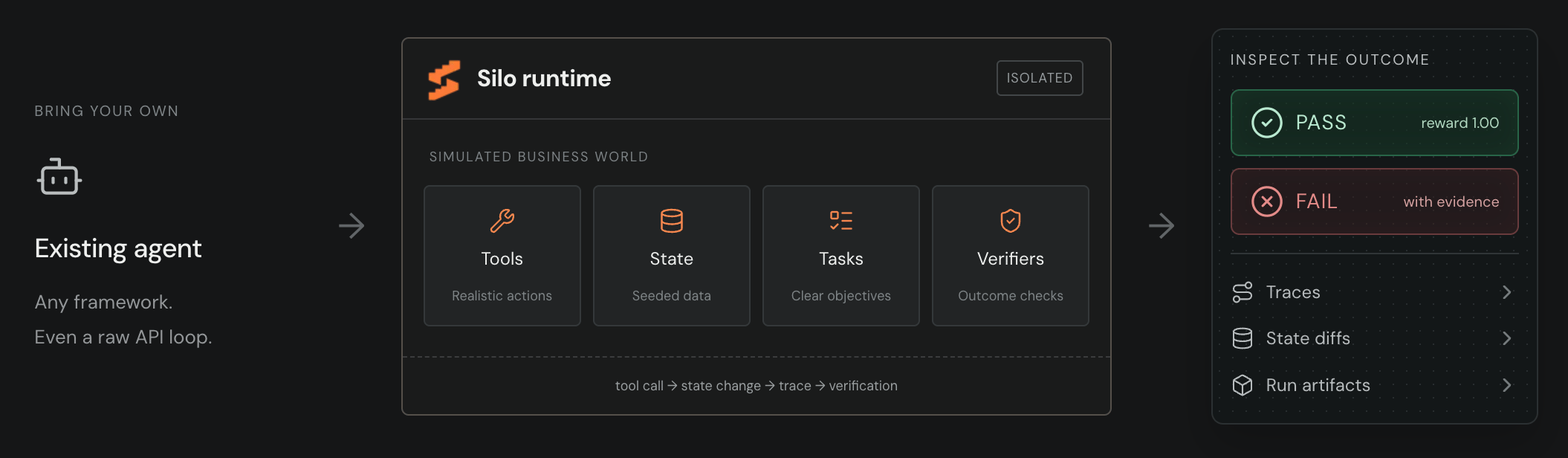
Why use Silo?
Without Silo:- Testing happens too close to production: Agents interact with real systems, fragile mocks, or hand-built test cases that are difficult to trust.
- Runs are hard to reproduce: Production systems and hand-built mocks can change between attempts, making failures difficult to compare or understand.
- A final answer does not tell the whole story: An agent can produce a convincing response while taking the wrong actions or leaving the underlying system in the wrong state.
- Controlled environments: Give agents simulated tools, data, state, and workflows without touching production.
- Reproducible runs: Start each run from a fresh copy of the environment’s initial state and inspect exactly what happened.
- Deterministic evaluation: Verify outcomes against the environment itself and keep traces, state diffs, rewards, and run artifacts as evidence you can inspect or use with coding agents like Claude or Codex.